

Silicon Dioxide Food Additive Top 10 Facts You Need to Know
2026-10-28
You sprinkle it into your morning smoothie, stir it into cake mix, and shake it over fries without a second thought—but how much do you really know about silicon dioxide? As one of the most common yet least understood food additives, it silently prevents clumping in nearly every powdered pantry staple. From its natural origins in quartz to its controversial nano-sized forms, this unassuming compound holds surprising secrets that could change the way you read labels. Whether you’re a cautious consumer or a food industry professional, these ten verified facts will strip away the myths and reveal what’s really on your plate. Brought to you with technical insight from Zhonglian, a leader in high-purity silica solutions, this guide is your shortcut to becoming ingredient-savvy.
What Exactly Is That Ingredient Listed as E551?
If you scan the ingredients list of certain packaged foods, instant soups, or grated cheeses, you might come across the cryptic code E551. It sounds like something from a laboratory, but its real identity is quite common: silicon dioxide, the same compound found in quartz, sand, and many types of rock. In the food industry, it serves a very practical purpose — preventing powdered ingredients from clumping together by absorbing moisture. Without it, your favorite spice blend might turn into a solid brick after a few humid weeks in the cupboard.
What makes E551 interesting is how it works at a microscopic level. Each particle is incredibly small and has a rough, porous surface that traps water molecules before they can cause stickiness between larger food particles. This keeps dry mixes free-flowing and extends their shelf life without adding any noticeable taste or smell. Because silicon dioxide is chemically inert and passes through the digestive system largely unchanged, many regulatory bodies, including the European Food Safety Authority, consider it safe for consumption at approved levels. However, there is ongoing debate about the effects of its nano-sized particles, which some studies suggest could interact with cells in ways bulk sand never would.
In practical terms, E551 shows up far more often than you might expect — not just in obvious items like powdered sugar or dried egg products, but also in seasonings, instant coffee granules, and even some vitamin supplements. If you want to avoid it, checking labels for "silicon dioxide" or "silica" is the first step, though it is so widespread that complete avoidance can be challenging. That said, the amounts used are typically very small, often less than 2% of the total product weight, and for most people it poses no immediate health concern. The real takeaway is that E551 is a perfect example of how modern food processing relies on materials borrowed from geology to solve everyday problems of texture and stability.
Why Your Spices and Powders Stay Free-Flowing
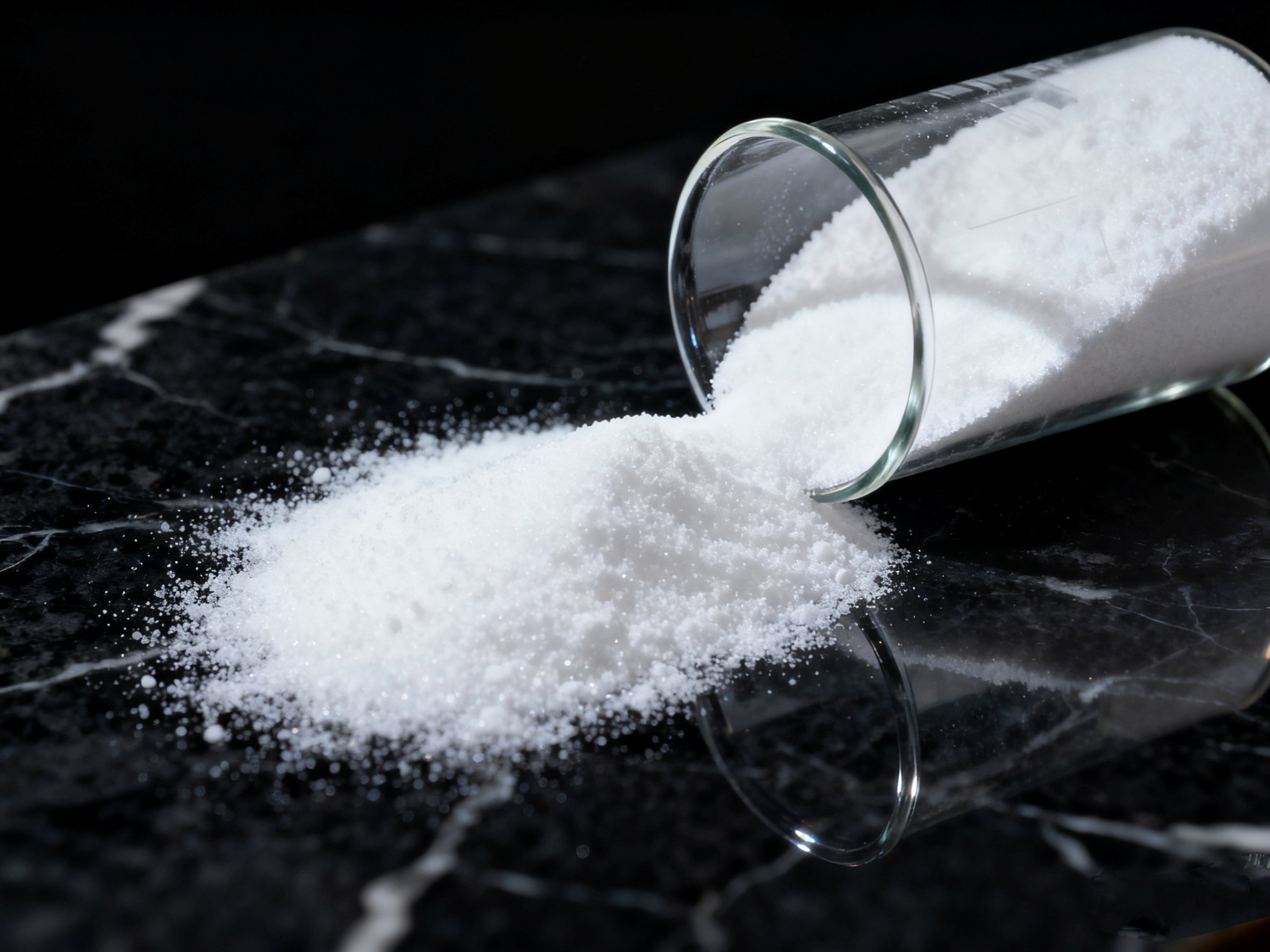
A clump-free jar months later isn't luck. Most spice blends and powdered ingredients are treated with something that coats individual particles to keep moisture from creating bridges between them. Without that barrier, even a small amount of humidity in the air would turn onion powder into a solid lump.
The usual additions are food-grade forms of silicon dioxide, calcium silicate, or tricalcium phosphate. They work at a scale too small to see, sitting on the surface of each grain and absorbing moisture before it can cause sticking. Because they don't dissolve or become sticky themselves, the powder remains loose and easy to pour.
Particle size also plays a role. Finely ground spices pack tighter and leave less room for air, but that same tight packing can trap humidity and promote caking. So manufacturers balance grind texture with anti-caking treatment. The result is the familiar tap-and-pour behavior we expect from paprika, cinnamon, and baking powder.
The Ongoing Safety Debate: What Studies Reveal
The conversation around helmet mandates keeps shifting as new data emerges. Some researchers point to injury rates dropping in cities with strict laws, while others note that helmet promotion campaigns may discourage casual riding, leading to fewer cyclists on the road and a weaker safety-in-numbers effect. The evidence isn't one-sided.
A closer look at hospital records shows head trauma accounts for a smaller share of cycling injuries than many assume, yet when it does occur, outcomes are disproportionately severe. Studies from trauma centers indicate that riders without helmets are more likely to require neurosurgical intervention, even if their overall crash rates are no higher. That distinction matters: frequency versus severity.
What is often missing from the debate is context. Suburban commuters face different risks than downtown delivery riders, and a policy that works in Copenhagen may not translate to Atlanta. The most compelling studies control for infrastructure, speed limits, and road culture—not just helmet use—which suggests the safety question is less about a single piece of equipment and more about how entire systems are designed.
How Much Do You Actually Eat Each Day?
Most of us have a rough idea of what we eat, but the details get fuzzy fast. That spoonful of peanut butter from the jar, the extra drizzle of olive oil in the pan, or the leftover crusts from your kid’s plate all count. When researchers ask people to log their meals, the numbers often don't line up with what participants estimated beforehand. It’s not lying—it’s simply that portion sizes and mindless snacking are easy to tune out.
There's also a big difference between planned meals and everything that happens around them. Coffee runs, free samples at the grocery store, a few chips while watching TV—these add up in ways hunger doesn’t fully register. If you want a clearer picture, try tracking everything for just three normal days. You might find your actual intake has more to do with convenience, boredom, or what’s sitting on the counter than with any real appetite.
The Nano Particle Question: Does Size Change Everything?
Take a lump of gold and it gleams yellow, but grind that same gold down to particles a few nanometres across and the colour shifts to red or even blue. This isn't a trick of the light—it's what happens when electrons get squeezed into spaces so small that their behaviour changes. At the nano scale, classical rules start to bend, and materials that we think we know begin to surprise us.
The real driver is surface area. A sugar cube has a certain surface, but split it into a billion nano-sized grains and you've exposed an enormous amount of that surface to the world. This is why nanoparticles make excellent catalysts, why zinc oxide sunscreens can be transparent yet still block UV, and why silver nanoparticles can kill bacteria with such efficiency. The chemistry hasn't changed, but the amount of material available to react has exploded.
Yet size doesn't rewrite every rule. Gold nanoparticles still have the same crystal lattice as bulk gold, and their melting point drops but doesn't vanish. The question "does size change everything?" is best answered with a cautious no—it changes many things, often dramatically, but never everything. The tricky part is predicting which properties will stay put and which will flip, and that's where the real science begins.
Silicon Dioxide vs. Silica Supplements: Not the Same
It’s easy to look at a supplement label, spot silicon dioxide in the ingredient list, and assume you’re getting a healthy dose of silica. But that assumption misses a key detail. Silicon dioxide is a basic chemical compound found in sand and quartz. In most supplements, it’s added as an anti-caking agent to keep powders from clumping—not as a source of silicon your body can actually use. Your digestive tract absorbs very little of it in this form.
Silica supplements are built differently. They typically deliver silicon as orthosilicic acid, often stabilized with choline, or through plant extracts like horsetail and bamboo. These forms are chosen because they’re more bioavailable—your body can take them up and put them to work in collagen production, bone maintenance, and connective tissue health. That’s a completely different job than preventing a capsule from sticking together.
So if your goal is to support hair, skin, nails, or joints, don’t mistake silicon dioxide on a label for a true silica supplement. The two are not interchangeable, and relying on the wrong one will leave you short on the absorbable silicon you’re after. Check the source of silicon before you spend your money.
FAQ
Not exactly. Food-grade silicon dioxide is a highly purified, synthetically produced amorphous form. The sand you're picturing is crystalline silica, which has a different structure and isn't allowed in food. The version used in foods is engineered to have extremely small, porous particles that are perfect for trapping moisture and keeping powders free-flowing.
It acts as an anti-caking agent. Many dry ingredients tend to absorb humidity and form lumps. Silicon dioxide creates a physical barrier around each particle, preventing them from sticking together, so you don't end up with a solid brick of garlic powder or a clumpy protein shake.
Regulatory bodies like the FDA and EFSA have reviewed it and consider food-grade silicon dioxide safe at typical levels. Most of it passes through your digestive system without being absorbed. Your body does use silicon as a trace mineral for bones and connective tissue, but the amount you get from food additives is tiny compared to what you naturally consume from water and plant foods.
You'll spot it on labels for dried soups, coffee creamers, grated cheese, cake mixes, seasoning blends, and especially powdered supplements like vitamins, pre-workouts, and meal replacements. It's also common in dried herbs and spices where even a little moisture ruins the texture.
For most people, no. Some early animal studies raised questions about nanoparticle forms and potential inflammation, but human data hasn't shown a consistent problem at the tiny amounts used in food. If you have a specific sensitivity or kidney condition, you might want to limit ultra-processed foods that contain it, but there's no widespread warning against it.
The FDA allows it at levels up to 2% by weight of a given food. In practice, most products use much less than that—often a fraction of a percent—just enough to keep powders dry and pourable. So a typical serving gives you only a few milligrams, far below any level linked to adverse effects.
Yes, especially in Europe and other regions, it appears as E551. You may also see it listed as 'silica,' 'amorphous silica,' or 'synthetic amorphous silica.' They all refer to the same anti-caking agent, though 'silica' alone can be ambiguous.
It’s already a natural part of your diet. Silicon dioxide occurs in many plant-based foods, including leafy greens, oats, and brown rice. So the additive form isn’t introducing a completely foreign substance—it’s more of a purified version of something your body is used to seeing.
Conclusion
Silicon dioxide, often listed as E551 on ingredient labels, is a ubiquitous anti-caking agent that keeps powdered foods, spices, and dried mixes from clumping. Despite its chemical-sounding name, it is essentially a purified form of the same compound found in quartz and sand. The food-grade version is manufactured to strict purity standards, yet its use has stirred ongoing safety debates. Some studies raise concerns about regular exposure, particularly regarding potential effects on gut health or inflammation, though regulatory bodies generally consider it safe at typical consumption levels. Estimates suggest most people consume a few milligrams to tens of milligrams per day, far below any established adverse threshold. However, the rise of nano-sized particles in some food-grade silica has prompted fresh scrutiny, since nanoparticles might behave differently in the body than larger particles. Still, evidence remains inconclusive, and many scientists call for more long-term human research.
It is also crucial to distinguish between food additive silicon dioxide and silica supplements marketed for hair, skin, or nail health. The additive is designed solely as a processing aid, not a nutrient, and its particle size, purity, and formulation differ significantly from those of dietary silica supplements. While both share the same chemical backbone, the body may absorb and metabolize them differently. For everyday consumers, the practical takeaway is that silicon dioxide in your spice rack or powdered drink mix is present in tiny amounts to maintain texture and shelf life. Rather than fearing E551, focus on a varied diet and be mindful that food additives are just one part of a much larger picture of dietary exposure. Understanding what this ingredient is—and what it is not—can help you make informed choices without unnecessary alarm.
Contact Us
Contact Person: Levin Wang
Email: [email protected]
Tel/WhatsApp: 8618668999988
Website: https://www.silicaplant.com/