

Custom Horizontal Machining Center Solutions for Precision Manufacturing
2026-09-22
Every precision part tells a story of compromises—until the machine itself is built around the process, not the other way around. At WINNRUI CNC, custom horizontal machining centers are engineered to erase those compromises, handling complex geometries, tight tolerances, and demanding materials with a rigidity and thermal stability that off-the-shelf machines simply can't match. But what does it actually take to tailor a machine to your production floor? This blog breaks down the real-world considerations, from spindle integration to pallet automation, so you can see where customization delivers measurable gains—and where it just adds cost.
Spindle Configurations Dialed Into Your Material Mix
A spindle that works beautifully for aluminum can fall flat when you swap in a block of Inconel. The difference is not just speed, it is the way torque is delivered at the low end. If your material mix includes both free-machining alloys and tough, gummy steels, a single fixed spindle ratio will force you to compromise on feeds, tool life, or surface finish. Dialing the configuration to your mix means choosing a motor and drive setup that can shift its performance envelope instead of sitting at one sweet spot.
High-speed spindles are great for small cutters and light chips, but they often lose torque right where harder materials demand it. A gear-driven or direct-drive spindle with a wide constant-power band lets you run fast for plastics and aluminum, then drop into a lower range for stainless or titanium without stalling. The real advantage shows up in mixed production runs, where you move from one material to the next without re-tooling the entire setup. It is less about having the highest RPM on paper and more about keeping the cutting edge stable across every material in your queue.
Pallet Automation That Keeps the Spindle Cutting
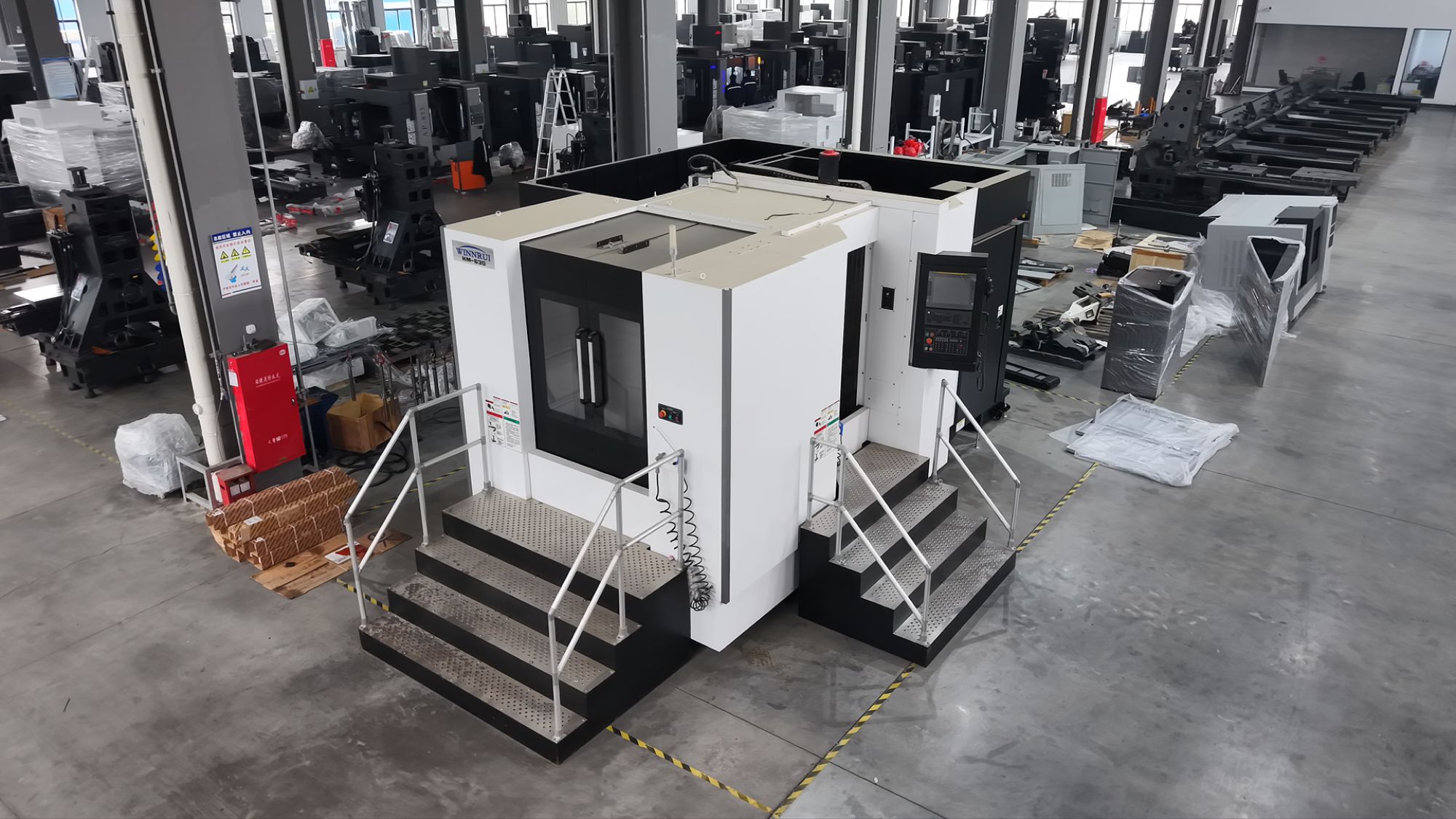
Many shops still treat pallet automation as a luxury, but the real benefit shows up when you look at spindle utilization. Instead of stopping to unload a finished part and clamp a new blank, the machine simply swaps pallets and keeps cutting. That uninterrupted cycle is where the profit hides—not in faster rapids or higher feed rates, but in eliminating those small idle windows that accumulate over a shift.
A well-integrated pallet system also changes how operators spend their time. Loading and unloading can happen away from the machine, often while the previous job is still running. This means setup work, deburring, or inspection no longer competes with machining time. The result is a calmer work area and a spindle that rarely waits for human hands.
The best systems don't force a choice between flexibility and uptime. You can run multiple part numbers across different pallets, set up new jobs offline, and still keep the machine fed around the clock. That kind of consistency is hard to achieve with manual loading, but it becomes the default once pallet automation is dialed in correctly.
Chip Evacuation and Coolant Flow Built for Unattended Runs
The chip conveyor uses a wide, slow-turning auger that pushes swarf toward the rear bin without letting curly stainless chips wrap around the shaft. A small lip at the discharge end keeps material from falling back into the machine, which helps when nobody is around to clear a jam at 3 a.m.
Coolant flow is split across three adjustable nozzles aimed at the tool's cutting edge, not the spindle housing. Since each line runs off a separate manifold, a single clogged nozzle won't shut down the cut. The tank includes a two-stage mesh filter that catches fine particles before they reach the pump, so pressure stays steady through a full overnight run.
Thermal Stability Engineered Into Every Casting
In the world of high-performance manufacturing, thermal stability is not a byproduct—it’s a deliberate design target. Every casting we produce begins with a metallurgical blueprint that accounts for grain structure, alloy distribution, and cooling rates. This isn’t about surviving a single heat cycle; it’s about maintaining dimensional integrity and mechanical strength across thousands of thermal excursions. We treat the foundry floor as a controlled thermal laboratory, where pour temperatures and mold preheats are tuned to within a few degrees, ensuring that the final casting resists creep, warpage, and micro-cracking long after competitors’ parts have started to drift.
What sets these castings apart is how we engineer the interface between material and temperature. Instead of relying on post-cast heat treatments to fix inconsistencies, we embed thermal resilience directly into the solidification process. Pattern geometry is adjusted for local thermal mass, risers are placed to feed critical sections without creating hot spots, and inoculation practices are refined to promote fine, stable carbide networks. The result is a casting that behaves predictably from ambient to elevated service temperatures—no sudden dimensional shifts, no hidden stress relief that reveals itself as a crack three months into operation. It’s the kind of quiet confidence that comes from knowing the part was born stable, not made stable after the fact.
Real-world thermal cycles are rarely linear, and neither is our approach to handling them. We simulate combined mechanical-thermal loading during the design phase, then validate those simulations with instrumented test pours and long-duration soak trials. Each batch includes witness coupons that are thermally cycled beyond specified limits and then sectioned for microstructural analysis. That data feeds back into the next revision of the gating and solidification model—so every casting lot improves on the one before it. When a customer installs one of our castings next to a furnace or deep inside an engine block, they’re not gambling on a spec sheet. They’re installing a component whose resistance to thermal drift was engineered, tested, and proven before it ever left the pouring line.
Control Interfaces Your Operators Already Trust
Operators don't want to relearn their job every time a system gets an upgrade. The control interfaces we deploy mirror the physical panels and software screens they've used for years—same switch positions, same color codes, same alarm priorities. That familiarity cuts hesitation during a shift change or a pressure spike, because muscle memory does half the work before conscious thought kicks in.
We've seen too many projects stall because a new dashboard looked impressive in a demo but forced operators to hunt for the emergency stop. Our approach keeps the trusted layout intact and only adds data where it actually helps—like trend lines next to the valve they already monitor. No hidden menus, no icon-only toolbars that require a training course to decode.
Maintenance teams benefit as well. When a pump trips at 2 a.m., the night crew doesn't have time to search through nested screens. They need the same red indicator and the same reset button they've pressed for a decade. By preserving those interface patterns, we reduce errors and keep veteran operators on board instead of pushing them toward early retirement.
Real Part Examples From High-Mix Precision Shops
In a shop that runs high-mix precision work, you don't see rows of identical parts coming off a line. A typical week might include a batch of thirty titanium bone screws with a 2 mm major diameter, a thread pitch tolerance of ±0.005 mm, and a required surface finish of Ra 0.2. Turning, thread whirling, and a final hand polish under a microscope are all done in-house because outsourcing any step would kill the turnaround time.
Another real example is a vacuum chuck for semiconductor wafer handling. The plate is 6061 aluminum, 300 mm across but only 8 mm thick after machining, with over four hundred 0.5 mm holes and a flatness callout of 0.005 mm. You have to rough it, stress relieve it, then semi-finish and finish on a five-axis machine with vacuum fixturing. Every hole gets checked on a CMM, and if one is out by more than 0.01 mm in position, the whole plate is scrap.
Then there are the Inconel 718 turbine blade cooling holes. These start as small drilled pilots and then get EDMed to 0.3 mm diameter with a depth-to-diameter ratio over ten. The material chews up carbide drills fast, so tool life monitoring is essential, and the process often shifts to femtosecond laser drilling for better edge quality. High-mix shops keep these recipes in an internal process library, so when a similar aerospace part arrives, they can adapt the proven approach instead of starting from scratch.
FAQ
Standard machines force you to adapt your process to their constraints. A custom build starts from your part tolerances, fixture needs, and pallet sizes, then matches spindle power, axis travels, and thermal stability to those specifics. That often means holding tight geometric tolerances with less compensation and fewer secondary setups.
We see the most demand from aerospace, defense, medical device, and high-end automotive suppliers—places where part geometry is awkward, materials are tough, and documentation is strict. They aren't buying a machine; they're buying a process that has to repeat within microns.
Horizontal spindles naturally shed chips better, but thermal drift is the real enemy. We use symmetric castings, core-cooled ballscrews, and spindle chillers tuned to actual duty cycles. Field validation includes cutting tests over 8-hour shifts to map stability before delivery.
Pallet pool size, tool magazine depth, and workpiece probing strategy usually move the needle more than raw spindle speed. A well-planned six-pallet system with automatic offset updates can keep the spindle cutting while you load, inspect, and adjust without pausing the line.
Yes, but we start with a simulation of your floor plan and part flow. That lets us match the machine's load height, door opening, and control interface to your robot or rail-guided vehicle before anything is fabricated. It prevents awkward retrofits later.
We usually begin with a fixture and tolerance review, then propose a kinematic layout and machine envelope. After approval, we build the base, spindle, and tooling interface, run a runoff at our plant with your parts, and only then ship and install. You're involved at each gate.
Because we designed and assembled it, we keep full CAD and controls documentation on hand. Remote diagnostics come standard, and we stock critical wear items that are unique to your build. For high-volume users, we offer quarterly laser calibration and ballbar checks under a service agreement.
Conclusion
Shops chasing tight tolerances across mixed material batches rarely benefit from a one-size-fits-all horizontal machining center. The right custom configuration starts with spindle selection that matches the actual work mix—high torque for stainless and titanium, higher RPM for aluminum—so you're not fighting chatter or burning through inserts. From there, pallet automation keeps the spindle cutting while operators handle setup or inspection, turning what used to be idle minutes into productive chip time. But throughput falls apart fast without reliable chip evacuation and coolant flow. Customized conveyors, washdown jets, and tank filtration tuned to your material types let the machine run unattended through long nights without stringy nests or coolant starvation.
Stability is just as important as speed. Thermal growth in castings quietly shifts hole positions over a long run if the machine isn't designed for heat dissipation and symmetric structure. Custom builders address this in the base casting and spindle housing, so warm-up cycles shrink and part dimensions hold hour after hour. On the floor, the control matters more than spec sheets suggest. Many precision shops ask for familiar interfaces—Fanuc, Siemens, Heidenhain—configured with their own macros and probing routines, which cuts training time and operator errors. The payoff shows up in real parts: medical device housings with ±0.0005 inch bores, aerospace brackets machined from forgings, hydraulic manifolds with cross-drilled passages. In each case, the custom HMC isn't a generic machine with options bolted on; it's built around the shop's recurring challenges, so the first article comes off closer to print and the tenth pallet mirrors the first.
Contact Us
Contact Person: Tim
Email: [email protected]
Tel/WhatsApp: +86 15522553731
Website: https://www.winnrui-cnc.com/