

Bulk Waste Tire Recycling Line Efficient Solutions for Sustainable Rubber Recovery
2026-09-10
Tire piles are more than an eyesore—they're a missed opportunity. With the right bulk waste tire recycling line, you can turn thousands of discarded tires into high-quality rubber ready for new products. SFC builds exactly that kind of efficient, heavy-duty system. Here's what makes a sustainable rubber recovery line actually work in the real world.
From Whole Tires to Reusable Rubber: What High-Volume Processing Actually Demands
Transforming scrap tires into reusable rubber at scale is far more than a matter of shredding and grinding. The real challenge lies in managing the input stream itself: whole tires arrive with embedded steel belts, fabric cords, and varying rubber compounds that resist uniform breakdown. Without precise size reduction stages and aggressive magnetic separation, downstream equipment quickly clogs, and output quality becomes inconsistent. This is where most operations stumble—not in the concept, but in the daily grind of keeping material flowing through multi-stage granulators and cracker mills.
High-volume processing also forces a rethink of thermal and mechanical stress. Rubber heats up rapidly under shear, and if temperatures spike, the material degrades or even ignites. Effective systems demand continuous cooling—water jackets, air classification, or cryogenic assist for certain feedstocks—paired with real-time monitoring of mill gaps and rotor speeds. Operators who overlook these variables end up with fine rubber powder that fails to meet specifications for molded products or asphalt modification, wasting both energy and input material.
Finally, the economics of scale hinge on end-product purity and consistency. Buyers of crumb rubber and micronized powder expect tight particle size distribution and minimal fiber or steel residue. Achieving that at hundreds of tons per day requires not just robust machinery but a closed-loop approach to dust control, noise abatement, and wear-part replacement schedules. The facilities that thrive are those treating the process as a continuous, integrated system rather than a series of standalone machines.
Why Oversizing the Shredder Won't Fix a Bottlenecked Recycling Line
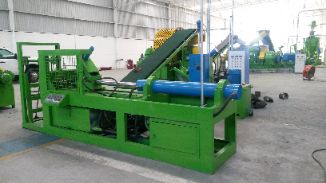
Oversizing a shredder is a common knee-jerk reaction when a recycling line stalls, but the fix usually ignores the real constraint. A larger machine doesn't change how quickly material moves through downstream screens, air classifiers, or optical sorters. Those components have fixed throughput ceilings, and feeding them more shredded material only piles up faster at their inlets. The bottleneck simply migrates a few feet down the line.
Many operators assume a bigger shredder means more consistent particle size, yet that's rarely the issue. The actual choke points are often caused by material wrapping around shafts, inconsistent feeding from upstream conveyors, or poorly calibrated density separation. Swapping in a heavier-duty shredder can even make things worse if it produces a wider size distribution that clogs finer screens. You end up with the same jam, just with a more expensive motor running it.
Before investing in larger equipment, map the material flow and measure wait times at each stage. A modest upgrade to the feeding system or a change in screen aperture frequently yields more throughput than a brute-force shredder swap. The goal isn't to shred faster—it's to keep every downstream unit running at its rated capacity without buffer overflow. Once you treat the line as a linked chain rather than isolated machines, the oversizing myth falls apart.
Keeping Contaminants Out of Recovered Rubber at Scale
At scale, the real bottleneck isn't grinding rubber down—it's keeping the unwanted bits out once the material has been reduced. Tire-derived feedstock arrives with steel belt fragments, polyester and nylon cord, road grit, and occasional tramp metal from the collection chain. Shredding and ambient or cryogenic milling liberate these contaminants, but they also create a fine, sticky matrix that traps fibers and metal dust. The result is that a single missed fragment can shut down a downstream extruder or compromise the properties of a molded part, so the separation train has to be designed for continuous, high-volume throughput rather than batch cleaning.
Most operations stack several physical separation stages in series. Powerful magnetic drums or overhead belts pull out ferrous steel after primary grinding, while air classifiers and zigzag sifters lift away lighter fluff such as polyester and nylon. Densimetric tables or hydrocyclones then separate heavier non-ferrous metals and mineral fillers from the rubber fraction. The key at scale is controlling particle size distribution before each stage—if the grind is too fine, air classification loses selectivity; if too coarse, embedded fibers remain locked in the rubber. Operators typically run closed-loop systems with real-time sampling to adjust mill gaps and airflow, since feedstock variability from different tire sources can throw off a fixed setting within hours.
One underappreciated aspect is dealing with oils, moisture, and chemical residues that arrive with post-consumer rubber. These don't respond to mechanical separation alone and often require a washing or thermal devolatilization step before final compounding. Some large recyclers have moved toward integrated lines where a pre-wash removes road salt and surface oils, followed by a low-temperature dryer to bring moisture below 0.5% before the material enters the grinding circuit. This reduces buildup on screens and magnets, and it also cuts the risk of volatiles causing porosity in subsequent rubber products. Without that front-end conditioning, even the best downstream separation equipment will struggle to hit consistent purity targets across thousands of tons per month.
Energy-Saving Designs That Don't Compromise Tire Throughput
Cutting energy consumption in a tire plant used to mean slowing down conveyors, reducing curing temperatures, or adding extra idle steps—all of which ate into daily output. The latest designs take a different route. They focus on recovering heat where it already exists and replacing fixed-speed motors with smarter, variable-speed systems that respond to real-time line conditions. The result is lower kilowatt-hour use per tire without adding seconds to a cycle or removing a single green tire from the queue.
Curing presses, for instance, now use multi-layer insulation and closed-loop steam recovery, so the heat that once escaped into the factory now preheats incoming materials. Hydraulic systems on tire-building machines are being swapped for servo-electric drives that consume almost nothing during idle yet still deliver full torque the moment a carcass drum starts spinning. Even the cooling lines have changed: instead of running fans at constant speed, they ramp down during brief gaps and spin back up instantly when the next batch arrives. No throughput is lost, because the equipment never waits for energy—it simply stops wasting it when the line pauses.
What makes these designs stand out is that they are tuned to actual production rhythms rather than theoretical best cases. Sensors track temperature, pressure, and material flow across the plant, and the control logic adjusts energy draw every few seconds. A shift change or a short maintenance window no longer means the entire facility keeps burning power at full rate. The plant still hits the same number of finished tires per shift, but the utility bill drops by double digits. For production managers who have been told for years that saving energy means sacrificing speed, this is a welcome correction.
The Role of Smart Automation in Reducing Labor and Downtime
Smart automation does more than replace manual steps; it changes where human attention goes. On a packaging line, for example, collaborative robots handle the repetitive pick-and-place and palletizing, while operators focus on changeovers, quality checks, and fine-tuning parameters. This shift cuts physical strain and reduces the small errors that happen when people repeat the same motion for hours. The result is not fewer workers but a clearer division between judgment-heavy tasks and machine-suited tasks.
Downtime gets attacked at the source. Vibration and temperature sensors on motors, gearboxes, and pumps feed data into models that learn normal operating patterns. When a bearing begins to wear, the system flags it days or weeks before failure, so maintenance happens during a planned pause rather than an emergency stop. Some plants pair this with automated root-cause analysis that scans recent alarms, setpoint changes, and operator inputs to shorten troubleshooting after any unplanned event.
Changeovers and scheduling also become less fragile. Automated tooling identification tells the machine which recipe to load, cutting setup time from forty minutes to under ten in many cases. Real-time production schedulers then reorder jobs based on actual throughput and material availability, avoiding the idle gaps that used to ripple through a shift. Together these moves keep labor focused on exceptions and keep lines running with fewer surprises.
Measuring What Matters: Payback, Purity, and Long-Term Rubber Supply
A rubber tree takes six or seven years before the first tapping. For smallholders who dominate global production, that waiting period is not just a biological fact—it is a financial cliff. Measuring payback therefore has to account for intercropping income, off-farm jobs, and the cost of replanting, not just the future latex price. Many projects fail because they treat payback as a simple rubber yield equation, ignoring the household cash flow gaps that force farmers to abandon immature plots.
Purity sounds straightforward until you follow the latex from cup to factory. Field coagulation methods, water quality, and transport time all leave fingerprints in the final rubber. Chasing a higher purity score can push processors toward more energy-intensive washing and drying, which may not improve downstream performance much. The useful measure is not a single lab number but the variance in contamination sources across different collection routes—knowing where dirt enters the chain matters more than repeating a specification sheet.
Long-term rubber supply is too often reduced to planted hectares. That misses the real dynamics: aging tree stock, low replanting rates in marginal areas, shifting climate suitability, and the simple question of whether young people want to tap trees at dawn. Without data on tree age distribution and replanting intentions, any supply forecast is guesswork. The metric that matters is not how much land is planted today, but whether the land will still be tapped in fifteen years.
FAQ
It combines a high-torque primary shredder with a multi-knife granulator, allowing it to process up to 20 tons of tires per hour without overheating. The integrated cooling system and automatic lubrication reduce downtime, and the line can switch between truck and passenger tires on the fly.
The process uses a dry, ambient grinding method that avoids chemical solvents or excessive water consumption. Rubber crumbs are separated by size using air classifiers, and the residual steel and fiber are sent to dedicated metal and textile recyclers, ensuring nearly zero waste from the input tires.
Depending on the screen configuration, the line produces rubber granules ranging from 0.5 mm to 4 mm, which are suitable for rubberized asphalt, playground surfaces, and molded products. A secondary fine grinding stage can also yield micronized rubber powder for new tire manufacturing.
Yes, the shredders are equipped with hardened alloy blades specifically designed to cut through steel-belted radial tires. A two-stage magnetic separation system removes 99% of the steel wire, and the remaining wire fragments are small enough to be passed to a smelter without further processing.
The main wear parts—shredder blades and screen meshes—are designed for quick replacement, typically taking under 30 minutes per station. Daily checks include conveyor belt tension and dust filter pressure, while the gearboxes use a sealed lubrication system that only needs oil changes every 2,000 running hours.
Absolutely, the modular design allows you to start with a 5-ton-per-hour base unit and later add extra granulators or a secondary screening module to double throughput. Conveyor widths and hopper sizes are adjustable, so the line can fit into existing facilities without major structural changes.
Each cutting chamber is enclosed with sound-dampening panels that reduce noise to below 80 dB at one meter. A central baghouse dust collector with a 99.9% filtration efficiency captures rubber fines, and the clean air is recirculated inside the plant to minimize energy loss from ventilation.
Conclusion
Turning whole scrap tires into reusable rubber at high volume is less about installing bigger equipment and more about balancing each stage of the line. A primary shredder, granulator, and screening system have to work in step; if downstream separation cannot keep pace, adding a larger shredder simply moves the bottleneck and wastes power. Real throughput depends on steady feed control, proper hook and screen configurations, and matching air or magnetic separation capacity to the particle size being produced. Contamination control is equally critical: steel wire, textile fiber, and dirt must be removed early and repeatedly, otherwise they degrade the purity of crumb rubber and shorten the life of downstream tools. Energy-saving layouts that use gravity transfer between stages, direct-coupled drives, and variable frequency control can maintain tonnage without excessive heat or noise.
Smart automation has moved from optional to essential for continuous operation. Sensors on bearings, belt misalignment, and chamber temperature allow operators to catch minor faults before they become downtime, while automated feed systems keep the line running with fewer staff. But the strongest argument for any configuration is the measurable return: payback time, output purity, and the ability to secure a consistent, high-quality rubber supply for molders, asphalt modifiers, or devulcanization. Facilities that track energy per ton, steel removal rate, and fiber content in the final product tend to make better retrofit decisions. In the end, an efficient bulk tire recycling line is not a collection of heavy machines but a synchronized process that turns a steady stream of end-of-life tires into clean, market-ready rubber without overloading labor, energy, or maintenance budgets.
Contact Us
Contact Person: Chen Zhengwei
Email: [email protected]
Tel/WhatsApp: +86-13963975727
Website: https://www.sfcrubbermachine.com